DDR5 RAM Memory Technology
💡 Quick Tip
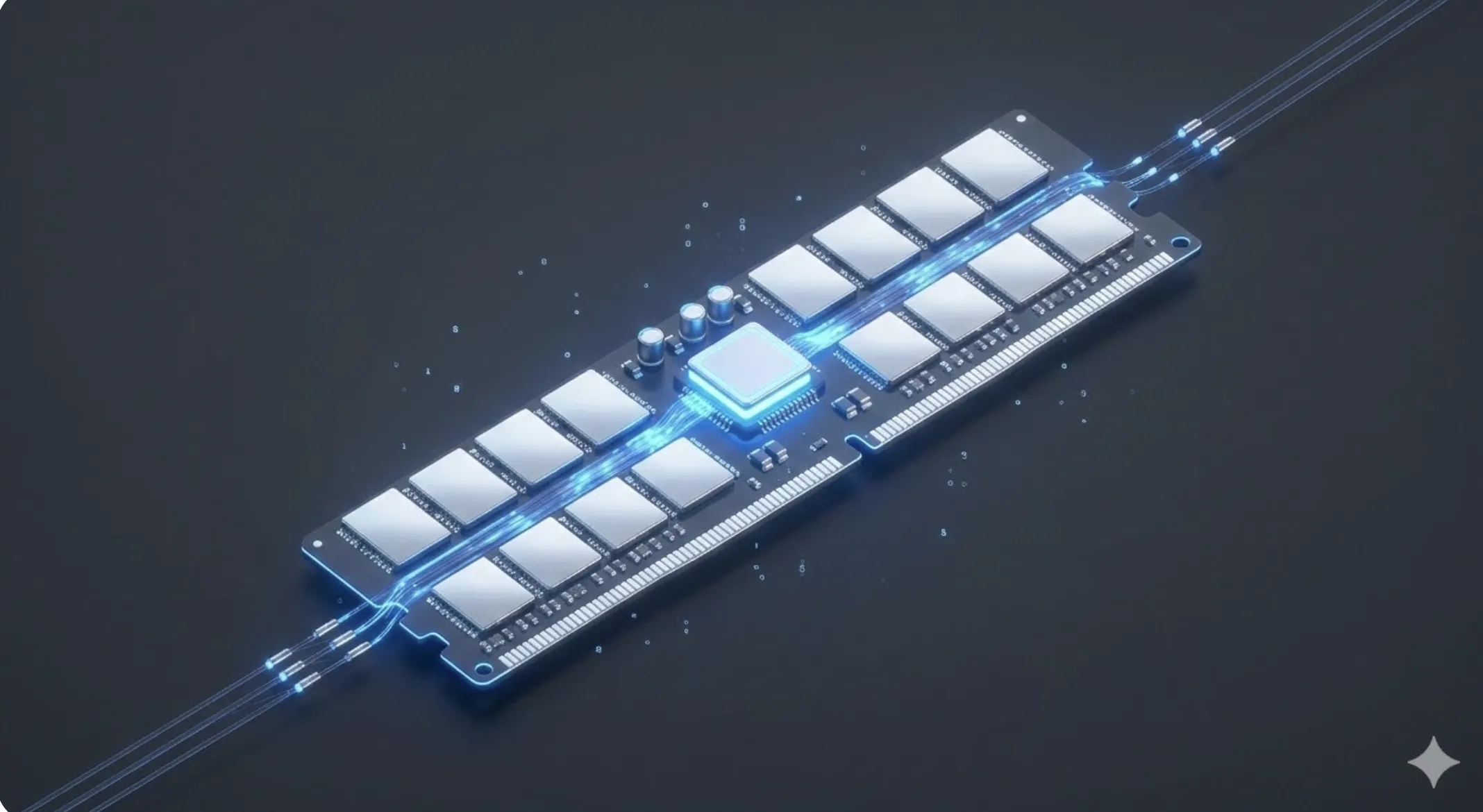
Key: DDR5 moves power management (PMIC) from the motherboard directly onto the RAM stick.
The Evolution to DDR5
Random Access Memory (RAM) has taken its biggest generational leap in a decade with the arrival of the DDR5 (Double Data Rate 5) standard. It is not just a speed increase; it is a complete restructuring of how the CPU interacts with temporary data. While DDR4 hit its practical ceiling around 3200-4000 MT/s, DDR5 starts where its predecessor ended.
Dual-Channel Architecture per Module
A major innovation is that a single DDR5 module now features two independent 32-bit channels (compared to the single 64-bit channel in DDR4). This allows the processor to perform multiple memory accesses simultaneously within a single stick.
On-die ECC (Error Correction Code)
Due to the extremely high density of DDR5 chips, the probability of errors from thermal noise increases. To mitigate this, DDR5 incorporates On-die ECC to correct errors within the memory cells themselves.
📊 Practical Example
Real-World Scenario: Diagnosing Instability in a High-Performance System
Step 1: BIOS Check. For DDR5, automatic overclocking profiles (XMP/EXPO) require precise voltages managed by the module's PMIC. Ensure the motherboard has the latest firmware for PMIC controller compatibility.
Step 2: Thermal Monitoring. Unlike DDR4, DDR5 PMICs generate heat. Ensure case airflow is sufficient to cool the modules to avoid thermal throttling.