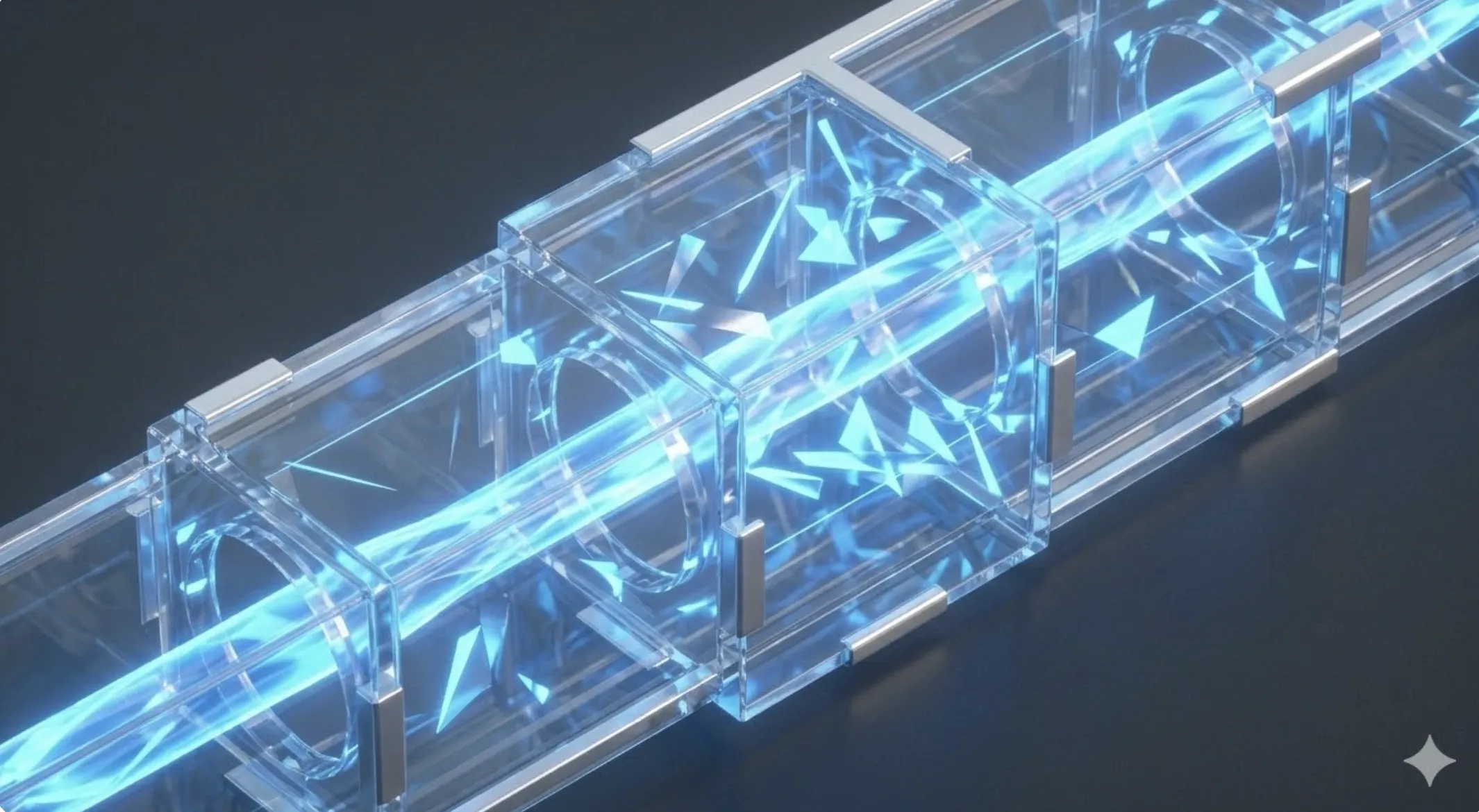
Fiber Optic Infrastructure: Data at the Speed of Light
💡 Quick Tip
Key: Fiber optics do not carry electricity, making them immune to electromagnetic interference.
The Principle of Total Internal Reflection
Fiber optics use pure glass or plastic filaments, as thin as a human hair, to transmit data via light pulses. Its operation is based on total internal reflection. The fiber core has a higher refractive index than the cladding. When light enters at a specific angle, it bounces continuously inside the core with minimal signal loss.
Fiber Types: Single-mode vs. Multi-mode
- Single-mode (SMF): Has a tiny core (~9 microns). Light travels in a straight path. Ideal for long distances (kilometers) and extreme speeds.
- Multi-mode (MMF): Has a larger core (50-62 microns) allowing light to travel in multiple paths or "modes". Cheaper, used in data centers for short distances.
Wavelength Division Multiplexing (WDM)
The capacity of a single fiber strand is nearly limitless thanks to WDM. It sends multiple data signals simultaneously by assigning each a different wavelength (color) of light.
📊 Practical Example
Real-World Scenario: Fiber Optic Splicing after a Break
Step 1: Preparation. Strip the plastic coating to reach the glass strand. Use high-purity isopropyl alcohol for cleaning. Cleanliness is the most important technical step.
Step 2: Cleaving. Use a precision cleaver to get a perfectly flat 90-degree cut. Irregular cuts cause light scattering.
Step 3: Fusion. Place ends in the fusion splicer. The machine aligns cores and applies an electric arc to melt and join the glass. A good splice has a loss below 0.02 dB.
Step 4: Protection. Slide a heat-shrink sleeve over the joint and bake it to provide mechanical rigidity.