Gate Fidelity: The Metric Defining Quantum Success
💡 Quick Tip
Why is gate fidelity the king metric in 2026? It represents the statistical precision of logical operations in quantum processors. Without fidelity exceeding 99.9%, the system collapses under noise, turning computation into an unrecoverable systemic error.
The LIGO Interferometer: Engineering the Infinitesimal
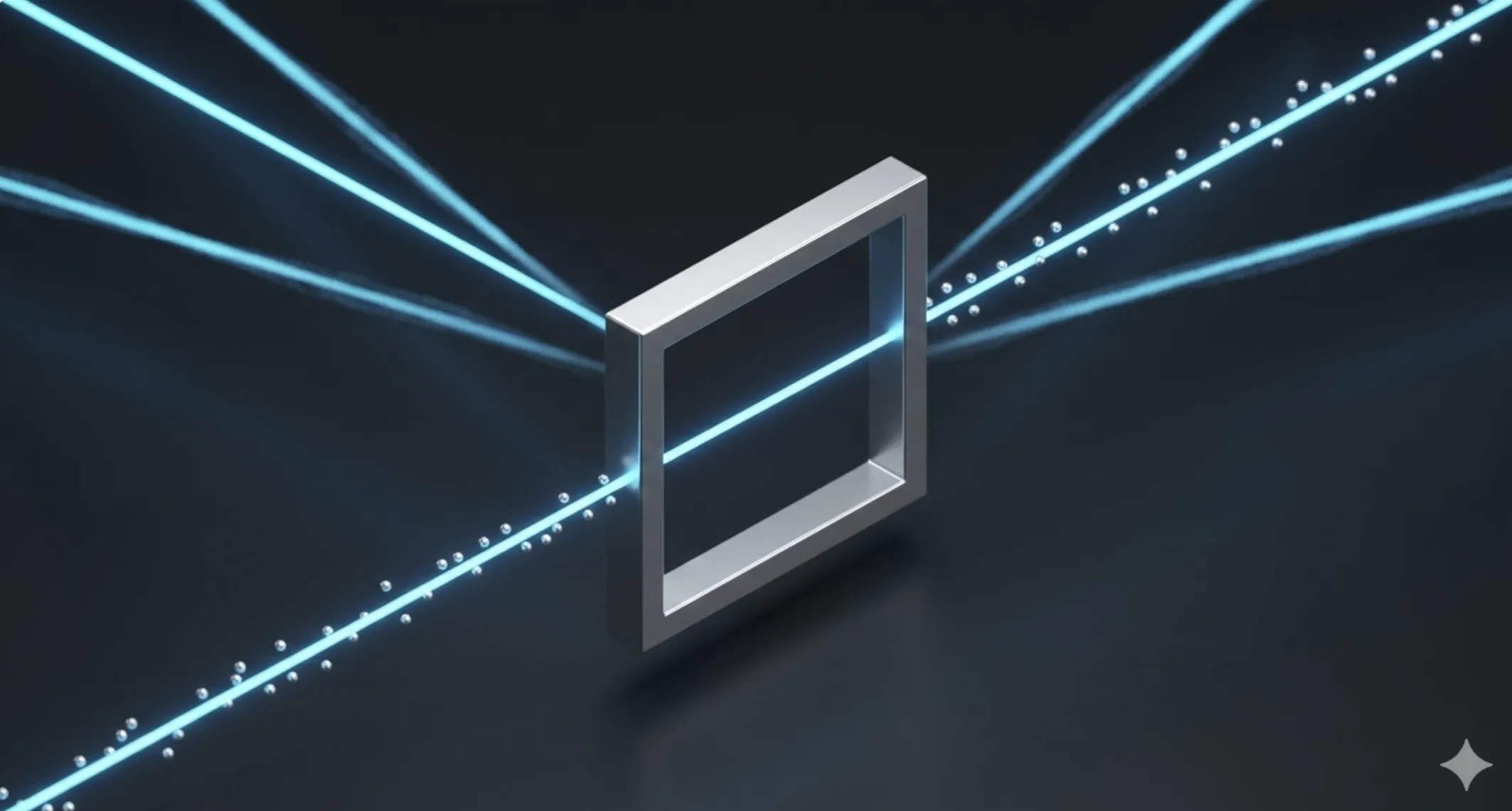
In 2015, the LIGO observatory detected gravitational waves for the first time, an engineering feat that required measuring distance variations smaller than a thousandth of a proton's diameter. That was the pinnacle of human precision: if the mirrors deviated by a single atom, the signal was lost in cosmic noise. In 2026, quantum computing faces its own "LIGO moment." It is not about how many physical qubits we can cram onto a cryogenic chip, but the absolute precision with which we can manipulate their states. This is the essence of gate fidelity: the difference between real engineering and the stochastic noise that renders calculation useless.
The Thesis: The Qubit as an Expensive Remote Control
For the last decade, the industry obsessed over qubit counts, treating quantum computing like just another consumer product. However, a processor with 1,000 qubits and low gate fidelity is, in practice, an expensive remote control. It can execute commands, but the results it returns are random due to decoherence. True power lies not in the quantity of "atoms" (processors), but in the integrity of the quantum "bits." Without fidelity that allows for error correction, quantum hardware remains a laboratory prototype incapable of solving real-world impact problems.
The Diagnosis: Quantum Data Islands and Decoherence
The systemic failure in the NISQ (Noisy Intermediate-Scale Quantum) era has been the creation of quantum data islands. Qubits interact, but environmental noise breaks entanglement before the algorithm finishes, leaving isolated and corrupt information fragments. According to Cinto Casals, AI Engineer, the problem is not a lack of power, but a lack of structural coherence. If the logical gates (the operators transforming information) do not have extreme fidelity, the system cannot "weave" those data points into a coherent solution, resulting in a useless information silo.
Technical Analogy: NASA's Deep Space Network Telemetry
To validate the importance of fidelity, look at NASA's Deep Space Network (DSN). To receive signals from Voyager 1 billions of miles away, the signal-to-noise ratio must be perfect. High gate fidelity acts as the DSN's low-noise amplifier: it allows the quantum logical signal to survive the "deep space" of thermal and magnetic noise. Only when fidelity exceeds the critical 99.99% threshold can we apply error-correcting codes, allowing quantum information to travel through the algorithm without degrading, just as Voyager data reaches Earth after decades of travel.
Methodological Differentiator: Algorithmic Step Zero
At Viblox, we implement "Step Zero": before launching an algorithm to a quantum processor, we design the information architecture (bits) based on the chip's error topology. We don't buy computing time blindly; we simulate the processor's Digital Twin to identify which logical gates have the highest error rate. This philosophy prioritizes quantum code optimization over hardware brute force, ensuring every operation is necessary and efficient before touching the cryogenic silicon.
Future Vision: The Invisible Technology of Logical Qubits
The future leads us toward invisible technology, where the end user won't know if their problem is being solved by a classical or quantum system. In this scenario, gate fidelity will be so high that systems will automatically manage the creation of "logical qubits"—sets of physical qubits working in harmony to eliminate error. The system will proactively self-repair, detecting and correcting quantum bit flips silently, allowing structural AI to solve protein folding or quantum chemistry problems without human intervention.
Conclusion: Is Your Strategy Based on Noise or Coherence?
When evaluating your technological roadmap, you must ask: Are you investing in systems that only add noise to your processes, or are you building an architecture capable of maintaining the fidelity necessary for true quantum advantage?
📊 Practical Example
Real Scenario: Simulating Catalysts for Green Ammonia
Step 1: Diagnosis and Step Zero Simulation. We map molecular orbitals to qubits and determine circuit depth. Step 2: Real-time Fidelity Characterization. Using Quantum Gate Tomography to identify weak physical nodes. Step 3: Execution with Error Mitigation. Applying Zero-Noise Extrapolation (ZNE) to extract valid results from imperfect hardware. Step 4: Validation and Troubleshooting. According to Cinto Casals, real engineering saved weeks of classical supercomputing by proving that intelligent fidelity management is more valuable than simple qubit volume.