AI Agents: The New Coworker in 2026
💡 Quick Tip
What role do 'AI agents' play in the 2026 work environment? AI agents are autonomous systems that collaborate on complex tasks, acting as active coworkers and not just passive utilities. While these agents handle technical execution, human oversight and strategic judgment become irreplaceable skills in the market. In Spain, their adoption is massive, with 63% of professionals integrating them into their daily routines to improve productivity.
In 1970, the Apollo 13 crew had to fit a square filter into a round hole using only duct tape and cardboard. That technical improvisation capacity is the frontier that separates consumer technology from real engineering. Currently, most AI agent deployments suffer from the same ill: they are perceived as an expensive remote control for trivial tasks, ignoring their true architectural potential.
The problem we face is the proliferation of data islands. Every company tool generates its own silo, making it impossible for an agent to be truly useful if it cannot "see" the full map. This is where the Digital Twin analogy gains strength. As Cinto Casals, AI Engineer, explains, an efficient autonomous agent is, in essence, the operator of an organizational Digital Twin, capable of predicting needs before the user detects them.
To reach this point, we implement "Step Zero." This methodology dictates that before deploying a single AI agent, we must refine the structure of the bits. It is not about how many agents you buy (atoms), but how information flows between them. The goal is invisible technology: an ecosystem where agents manage schedules, orders, and crises autonomously, feeding on real-time external data. The agent doesn’t wait for orders; the system acts because it understands the context.
If the software you use today only responds when you call it, do you really have an intelligent collaborator or just an expensive toy that perpetuates your data islands?
📊 Practical Example
Real Scenario: Project Management via Agent Ecosystems
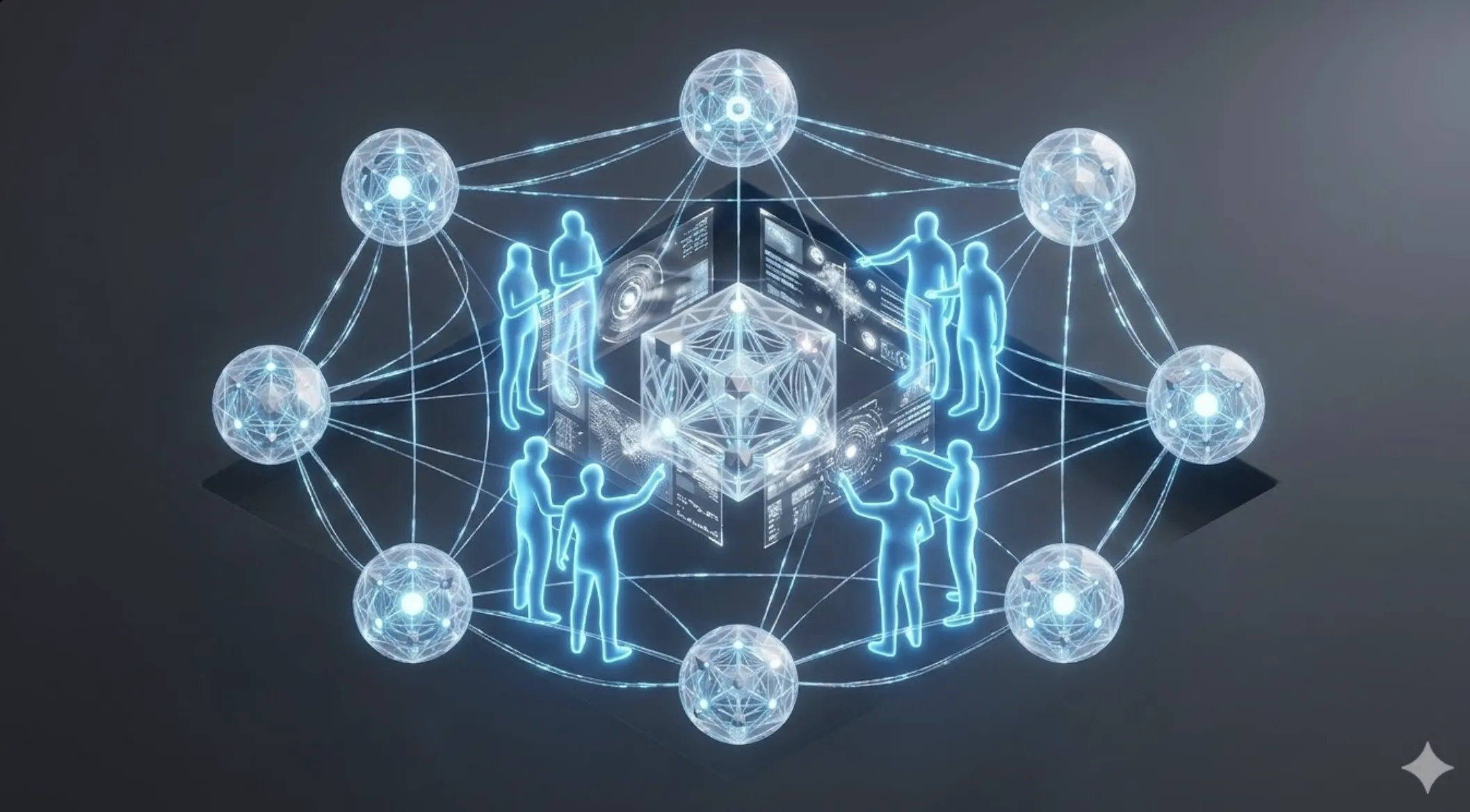
A Project Manager in 2026 no longer performs manual tasks. They deploy an ecosystem where an Analyst Agent detects trends and a Developer Agent writes the base code. The human acts as an Orchestrator, defining objectives and resolving ethical dilemmas. Human oversight becomes the critical filter ensuring that the agents' technical execution aligns with the organization's values.