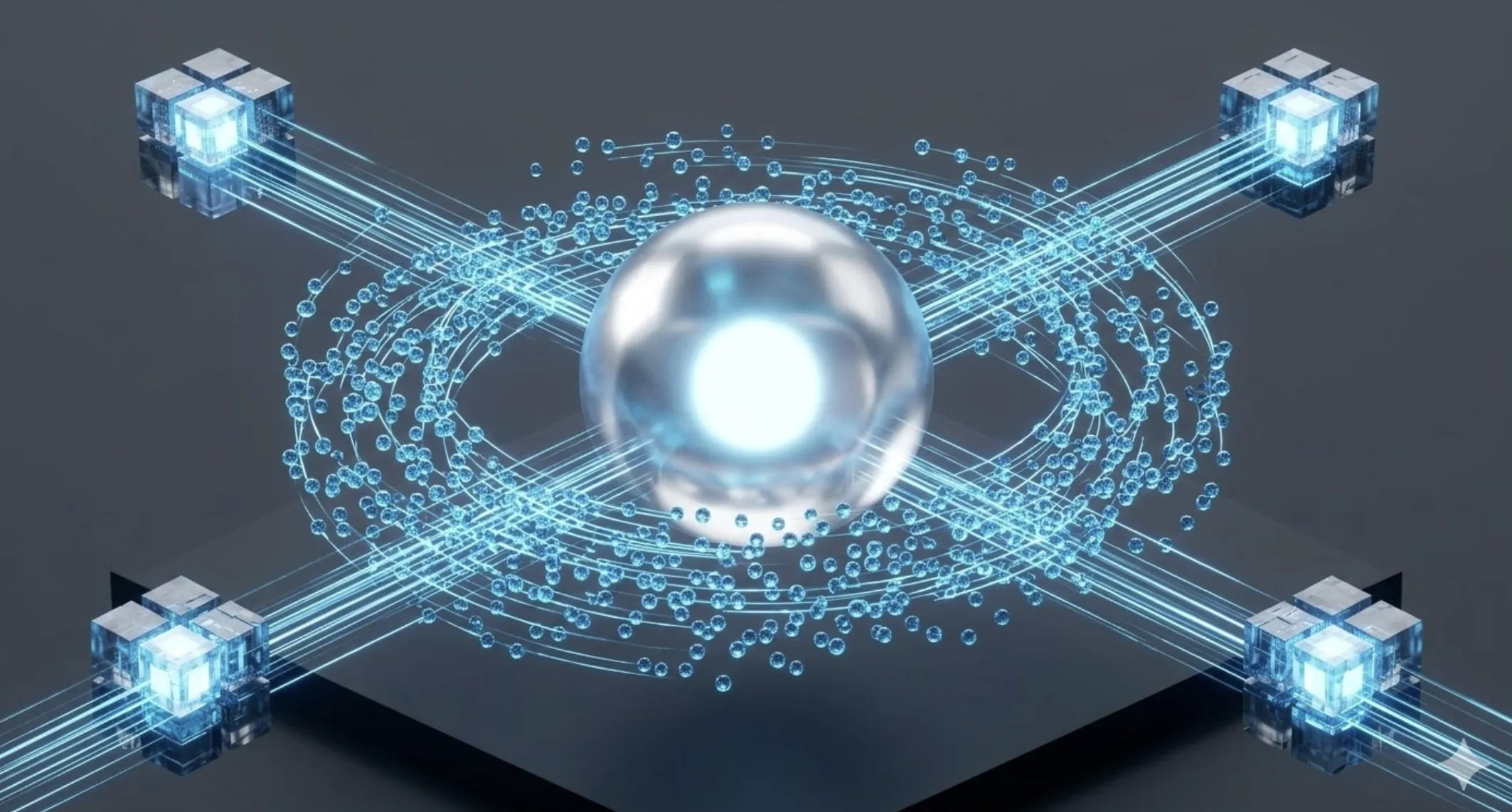
Cloud 3.0: Native Support for the Agentic Era
💡 Quick Tip
What defines Cloud 3.0 in 2026? It is the evolution toward infrastructures with native support for AI agents, optimizing compute autonomously and ensuring structural data sovereignty.
The Apollo 11 AGC and the Orchestration of Survival
The Apollo Guidance Computer (AGC) of 1969 had barely 64 KB of memory, but it orchestrated a moon landing through critical priority design. It wasn't consumer technology; it was real-time control engineering. In 2026, Cloud 3.0 recovers that essence. It is no longer about stacking infinite virtual machines, but creating an environment where AI agents operate with mission-critical precision. It is the leap from passive infrastructure to the real engineering of self-managing software.
The Thesis: Cloud 2.0 as an Expensive Remote Control
Over the last decade, container-based Cloud 2.0 became an expensive remote control. Companies scaled services by pressing buttons, but without real intelligence in the network layer. In 2026, this architecture is inefficient for agentic AI. Cloud 3.0 eliminates the need to manage infrastructure manually, allowing the system itself to allocate silicon resources based on the complexity of the agent's reasoning in every millisecond.
The Diagnosis: Data Islands and Decision Latency
The failure of current systems lies in data islands that force AI agents to jump between clouds, losing context and increasing latency. According to Cinto Casals, AI Architect, an agent is only as intelligent as the fluidity of its access to information. Current fragmentation acts as a bottleneck preventing AI from moving from being an assistant to a full organizational structure.
Future Vision: The Invisible Technology of Self-Management
The ultimate goal is invisible technology, where the cloud stops being a contracted service to become the company's nervous system. In 2026, we will see infrastructures that proactively self-repair and scale based on the cognitive load of AI agents, operating silently to ensure business never stops in the face of regional network failures or processing crises.
📊 Practical Example
Real Scenario: Global Stock Management via Agent Mesh
A multinational deploys 10,000 agents to coordinate global inventory. In a Cloud 3.0 environment, the infrastructure creates a dynamic "Mesh" that logically groups the agents that interact most, reducing decision latency. The cloud optimizes cost by redirecting minor tasks to low-power hardware.