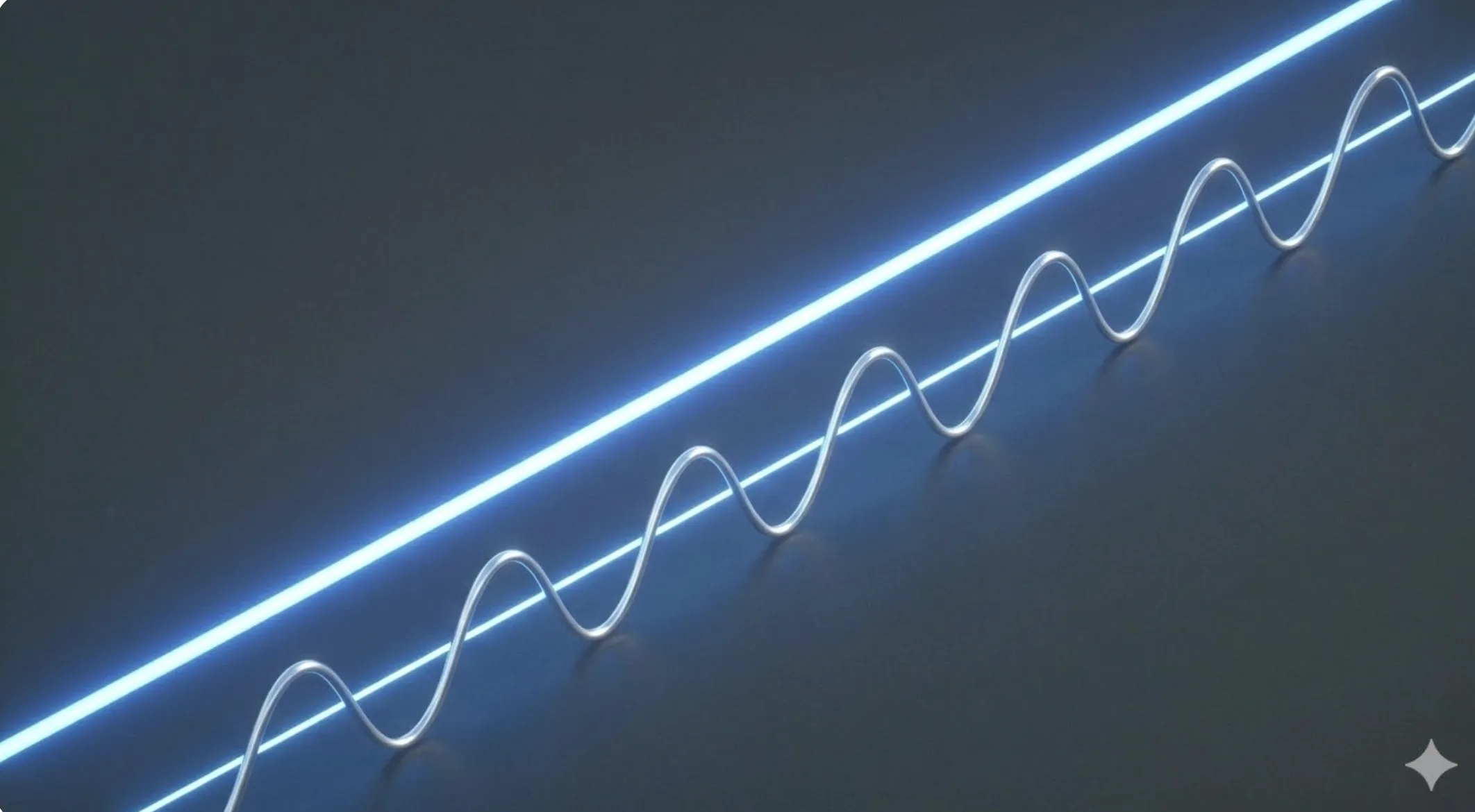
Electrical Quantities: Voltage, Amperage, and Resistance
💡 Quick Tip
Tip: Think of electricity like water: voltage is the pressure, amperage is the flow rate, and resistance is the pipe width.
The Pillars of Electricity
To understand any electronic system, it is imperative to master the three fundamental quantities that govern electron movement: Voltage (Tension), Amperage (Intensity), and Resistance. These three variables are intrinsically linked by Ohm's Law, which states that the current intensity is directly proportional to voltage and inversely proportional to resistance ($I = V / R$).
Voltage (V): The Potential Difference
Voltage, measured in Volts (V), is the electromotive force that "pushes" electrons through a conductor. Technically, it is the electric potential difference between two points. Without this difference, electrons have no reason to move.
Amperage (I): The Charge Flow
Current intensity, measured in Amperes (A), quantifies the amount of electric charge (electrons) flowing past a point in a conductor per second. One ampere equals one Coulomb per second. It determines the necessary wire thickness: higher amperage generates more heat due to friction, requiring larger gauge conductors to prevent fires.
Resistance (R): The Opposition to Flow
Resistance, measured in Ohms (Ω), is the property of materials to oppose the flow of electrons. All materials, except superconductors, present some resistance. Precision control of this quantity using resistors allows for regulating the behavior of complex circuits.
📊 Practical Example
Real-World Scenario: Calculating Voltage Drop in a LED Installation
Step 1: Problem Identification. You want to install a high-power LED strip consuming 10A at a distance of 15m. A thin cable causes the end LEDs to dim. The cable's own resistance is consuming voltage, known as technical "voltage drop".
Step 2: Resistance Calculation. A 1.5mm² copper wire has a resistance of approx 0.012Ω/m. For 30m of total wire (round trip), $R = 30 \cdot 0.012 = 0.36\Omega$.
Step 3: Ohm's Law Application. The drop will be $V = I \cdot R = 10 \cdot 0.36 = 3.6V$. If the source is 12V, the strip only receives 8.4V.
Step 4: Technical Solution. Increase the cable gauge to 4mm² or 6mm² to reduce $R$. Lower resistance decreases voltage drop, ensuring the LEDs receive their required nominal voltage.