How a Modern GPU Works: Beyond Pixels
💡 Quick Tip
Tip: The key difference of a GPU is its massively parallel processing capability (SIMD).
Parallel Architecture of the GPU
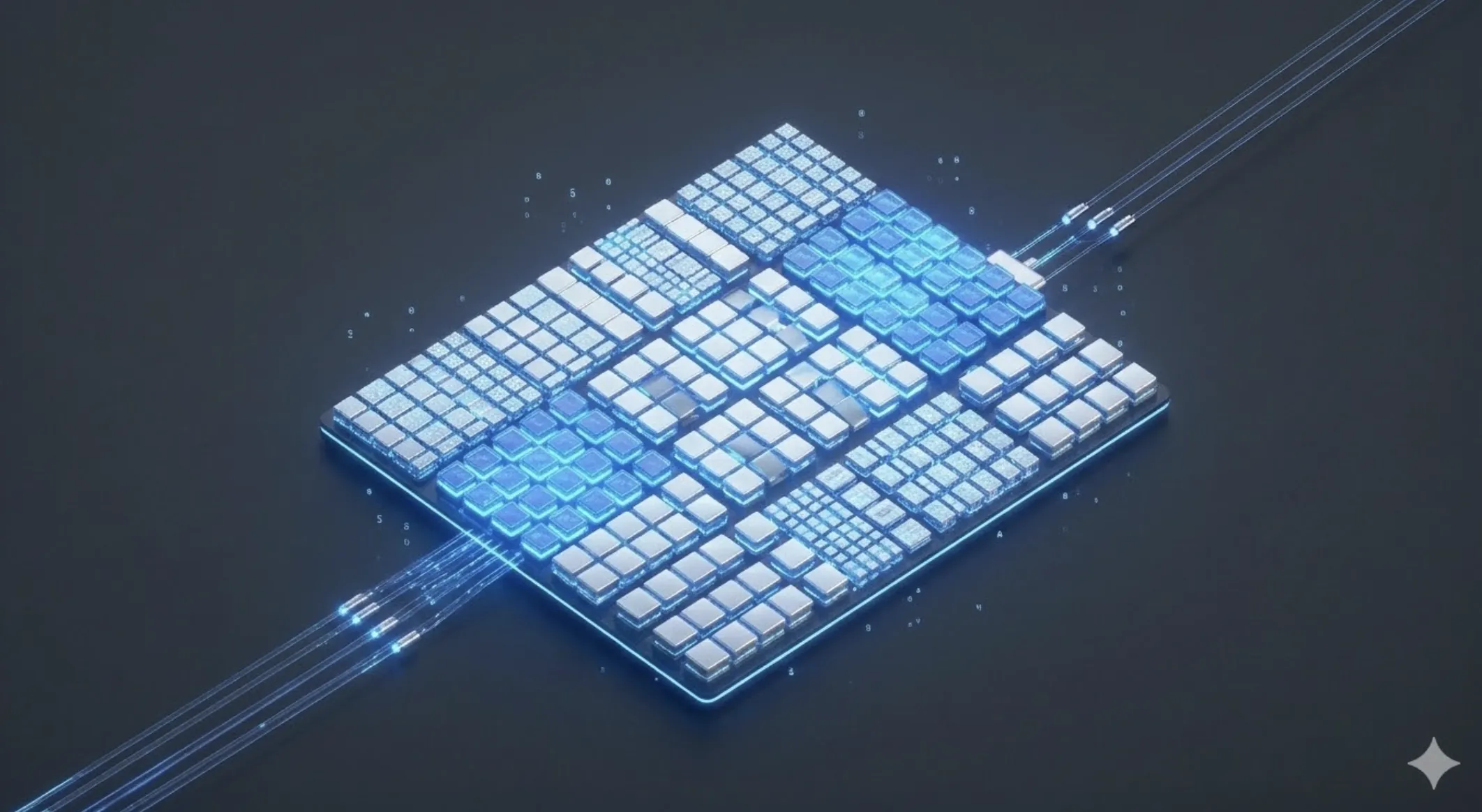
Unlike a CPU, which has a few cores optimized for sequential tasks, a Graphics Processing Unit (GPU) contains thousands of small cores designed to perform the same mathematical operation on large volumes of data simultaneously (SIMD).
Ray Tracing and RT Cores
Modern GPUs include dedicated hardware called RT Cores. These cores are specialized in calculating light ray intersections with 3D geometries, simulating realistic reflections and shadows.
Tensor Cores and AI
Tensor Cores are units designed for complex matrix operations, the heart of Deep Learning. This enables technologies like DLSS, where AI reconstructs high-resolution images from lower-resolution ones.
📊 Practical Example
Real-World Scenario: Optimizing a Workstation for Machine Learning
Step 1: Driver Installation. Install "Studio Drivers" (NVIDIA) instead of "Game Ready" drivers to prioritize compute stability and Tensor core usage.
Step 2: VRAM Monitoring. If the model exceeds VRAM capacity, the system will swap to system RAM, reducing performance by 90%. Reduce the "batch size" in your code to ensure everything fits in the GPU memory.