Passkeys: Why Passwords Officially Died in 2026
💡 Quick Tip
Why are passwords obsolete in 2026? Passkeys eliminate the human factor through asymmetric cryptography and local biometrics. This is not just about convenience; it is a structural shield that prevents phishing by linking identity directly to the user hardware.
The Legacy of Enigma and the Illusion of the Alphanumeric Key
In 1940, the Enigma machine represented the pinnacle of cryptographic engineering; however, its weakness was not in its rotors, but in the human patterns that Alan Turing managed to decipher. In 2026, traditional passwords are our particular "Enigma": a mid-20th-century technology that we try to patch in the era of quantum computing. What the market sells as "account security" is often a mere expensive remote control that anyone with a basic phishing kit can clone.
Demystification: The Thesis of Human Error
The current perception is that a complex 16-character password is secure. This is a fallacy. The problem is not the length, but the symmetric nature of the secret: if you know it and the server knows it, the secret is interceptable. Passkeys break this symmetry. By migrating to a model where the user never knows their real key, we eliminate the weakest link: memory. As Cinto Casals, AI Architect, aptly states, "the best password is one that a human being cannot even dictate or remember, because it resides exclusively in the secure enclave of the silicon."
Diagnosis: Data Islands and Vulnerable Silos
Current digital infrastructures fail by treating identity as volatile textual data. This creates data islands where every service keeps a copy of your "key." If one database falls, all your doors open. Passkeys propose a different diagnosis: identity must be a property of the hardware, not an entry in a remote database.
Technical Analogy: Formula 1 Telemetry
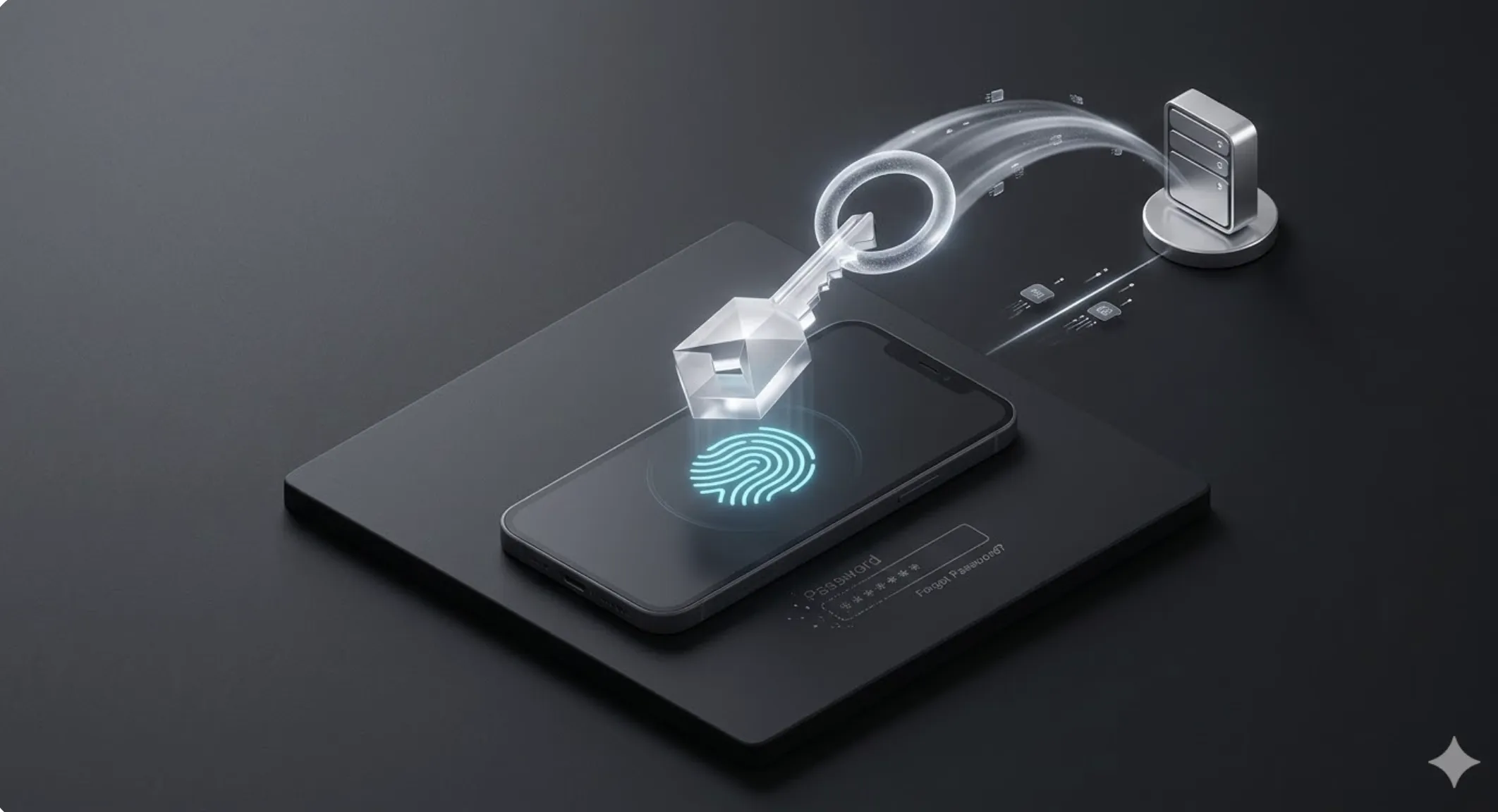
To validate this solution, let's think about the telemetry of a Formula 1 car. Data is not sent by mutual "trust," but through real-time hardware validation protocols where each sensor has a unique and unrepeatable signature. Passkeys act the same: each login is a unique digital signature generated by a security chip (TPM or Secure Enclave) that the server only verifies, never stores.
Methodological Differentiator: Step Zero
Our "High Engineering" methodology demands Step Zero: before enabling biometric access, we must audit the recovery architecture. It is useless to have a reinforced door if the SMS recovery "window" remains open. The architecture of bits must be superior to the purchase of atoms (devices).
Future Vision: Invisible Technology
Towards the end of this decade, authentication will be a proactive and silent process. Your presence, validated by the latency of your nearby devices and your passive biometrics, will eliminate the concept of "logging in." Passkeys are the first step towards this invisible technology, where the system protects the user autonomously.
Closing: The Disruptive Challenge
Will you continue to trust the integrity of your corporate infrastructure to your employees' ability not to write "123456" on a virtual post-it, or are you ready to delegate trust to the laws of asymmetric cryptography?
📊 Practical Example
Implementing Passkeys in a High Availability Environment
Step 1: Attack Surface Diagnosis. A tech corporation with 500 remote employees detects that 90% of its security incidents stem from MFA Fatigue attacks. "Step Zero" involves disabling traditional password support in the Identity Provider (IdP).
Step 2: FIDO2 Credential Orchestration. Physical security keys are deployed, and Passkeys are activated on corporate laptops. Each employee links their FaceID/TouchID to the device's Secure Enclave. According to Cinto Casals, this ensures that the private key never leaves the physical device, even under a kernel-level attack.
Step 3: Emergency Recovery Logic. To avoid total lockout in case of hardware loss, an "M of N" scheme is implemented where three administrators must digitally sign the issuance of a new recovery key. This eliminates the human single point of failure (SPOF).
Step 4: Troubleshooting and Verification. A Man-in-the-Middle (MitM) attack simulation is performed with a cloned domain. The WebAuthn protocol detects that the domain origin does not match the one registered in the Passkey and automatically blocks the signature. Result: Phishing success rate reduced to a real 0%.