Why you are not reaching 10 Gbps: Network Bottlenecks
💡 Quick Tip
10 Gbps fiber performing like 1 Gbps? The problem isn't your ISP; it's your local physical layer. From obsolete NIC cards to Cat 5e cables, bottlenecks are the silent saboteurs of ultra-high speed in 2026.
The Grand Canyon and the Hydraulic Funnel Effect
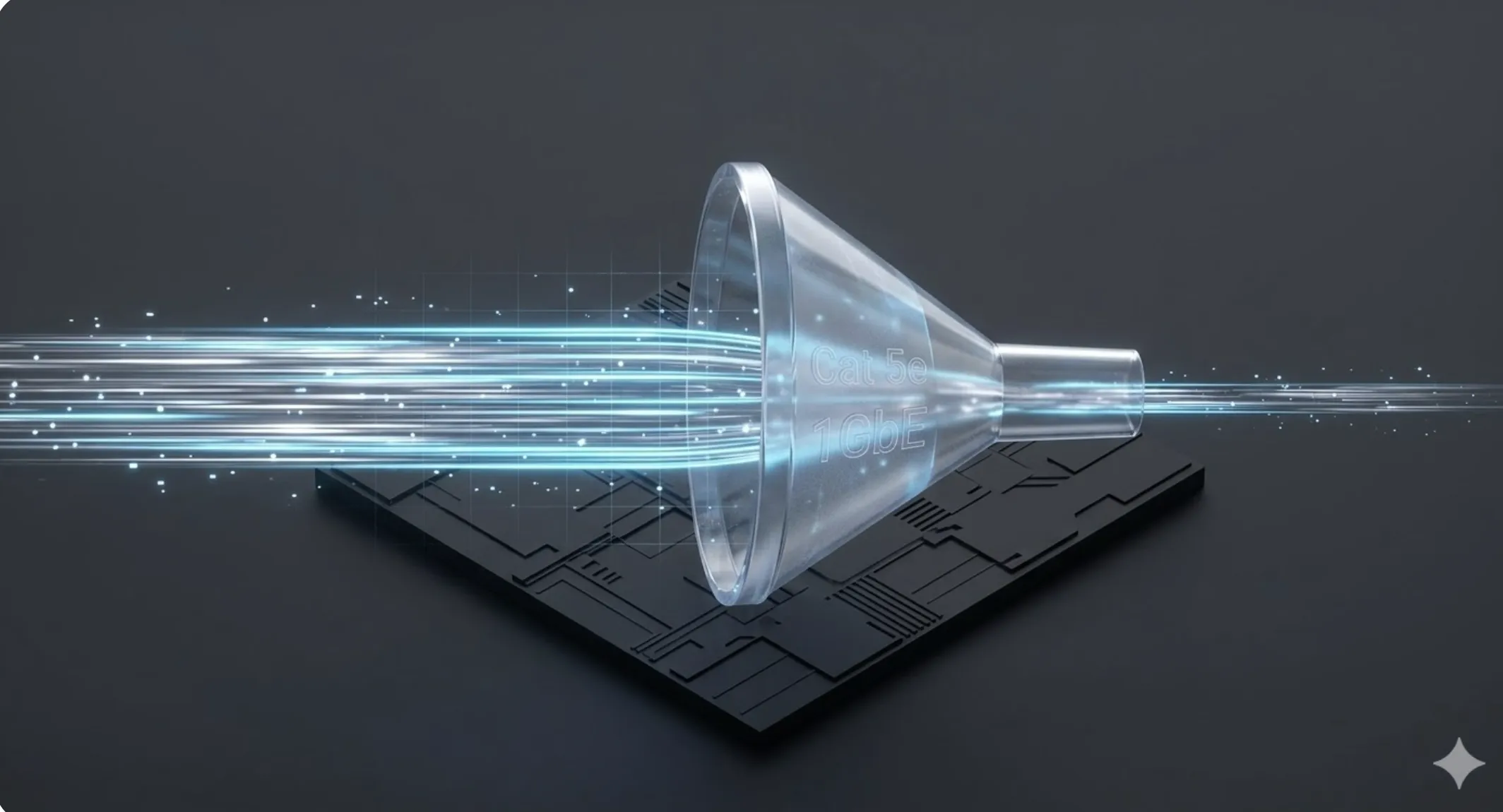
In civil engineering, an infinite reservoir is useless if the output pipes are straw-sized. In 2026, users paying for 10 Gbps symmetrical and receiving 940 Mbps live a digital hydraulic paradox. High engineering teaches that a network is only as fast as its weakest link.
Demystification: The "Plug and Play" Lie in Multigigabit
Commercial perception suggests just plugging in a cable is enough. It's a technical fallacy. 10 Gbps operates at such high frequencies that copper imperfections cause parity errors. As Cinto Casals, AI Architect, describes, "moving 10 gigabits per second is not a software task; it's a challenge of materials physics and CPU interrupt management."
Diagnosis: Data Islands of Obsolete Hardware
Diagnosis often reveals data islands trapped in PCIe 2.0 buses. Even if the router delivers the signal, the OS must be able to "ingest" that data. Lack of Jumbo Frames support acts as an invisible wall.
Technical Analogy: Ka-Band Satellite Telemetry
Imagine a modern satellite trying to send data to an 80s ground station. The signal is there, but reception is physically impossible. This is your Cat 5e cable trying to carry a 2026 XGS-PON signal.
Methodological Differentiator: Step Zero of Hardware
Step Zero is the physical layer audit. Before buying atoms (hardware), check if your NIC is 10GBASE-T and your PCIe bus has free lanes. Information architecture must be ready for the bit tsunami.
Future Vision: The End of Copper at Home
By 2027, invisible technology will shift toward Plastic Optical Fiber (POF), eliminating electromagnetic interference. 10 Gbps will be the base standard.
Closing: The Disruptive Question
Will you keep paying for a ten-lane highway while driving a vehicle limited to 100 km/h by its own internal infrastructure?
📊 Practical Example
Real Scenario: 10G Network Upgrade
A user with 10 Gbps fiber only gets 1 Gbps in speed tests. After diagnosis, a 10GBASE-T PCIe card is installed and Cat 5e cabling is replaced with Cat 7. After configuring Jumbo Frames, the effective speed rises to 9.4 Gbps.