Zener Diodes in Voltage Regulation
💡 Quick Tip
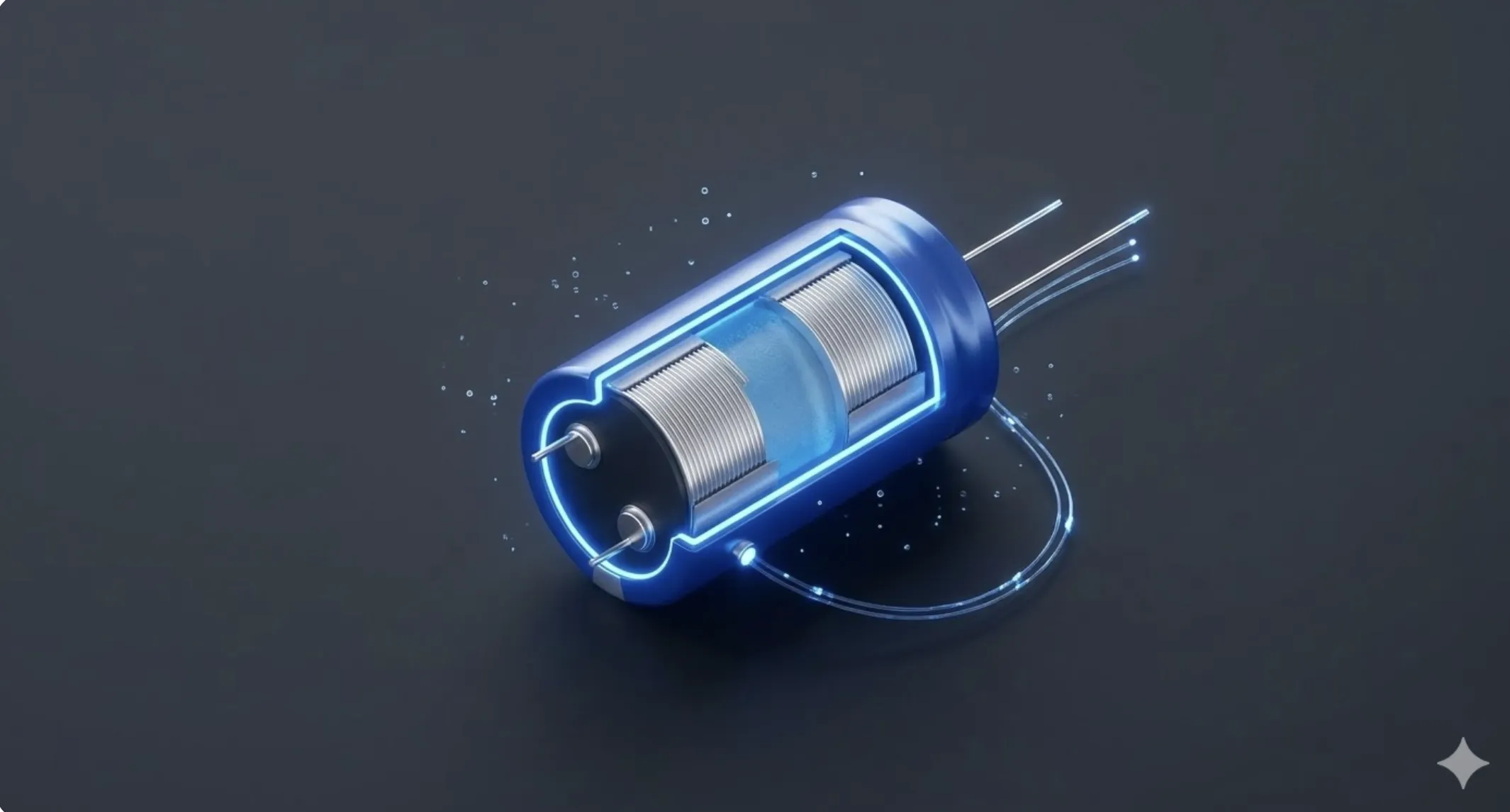
Zener diodes are specialized semiconductors designed to operate safely in the reverse breakdown region. Unlike standard diodes, they maintain a constant voltage (Zener Voltage) once their threshold is reached, making them ideal low-cost regulators. Their correct implementation requires precise calculation of a series limiting resistor to prevent the current from exceeding the maximum power dissipation of the component. They are fundamental for stabilizing voltage references in analog circuits and protecting digital inputs against unexpected voltage spikes in high-precision embedded systems in industrial environments.
Introduction to the Zener Diode
Unlike standard diodes that block current in reverse until they are destroyed, the Zener diode is specifically engineered to operate safely within the "breakdown" region. When a specific reverse voltage threshold is reached—known as the Zener Voltage ($V_Z$)—the diode begins to conduct current in reverse while maintaining a nearly constant voltage across its terminals, regardless of current fluctuations.
Physical Principles: Zener vs. Avalanche Effect
This component utilizes two distinct physical phenomena: the Zener Effect (dominant below 5V) and the Avalanche Effect (dominant above 6V). In engineering practice, this allows the creation of highly stable voltage references. For instance, a 5.1V Zener diode will lock the voltage at 5.1V as long as the current stays between its minimum knee current ($I_{ZK}$) and its maximum power rating ($P_D$).
Key Applications
- Voltage Regulation: Providing a stable voltage rail for low-power sensors or microchips.
- Overvoltage Protection: Serving as a "clamper" that redirects voltage spikes to ground to protect sensitive inputs.
- Level Shifting: Shifting the reference level of analog signals for proper processing.
Crucially, a Zener diode must always be used with a series resistor ($R_S$) to limit the current. Without this resistor, the diode would attempt to absorb all the power from the source and burn out instantly.
📊 Practical Example
Real-World Scenario: Voltage Reference Stabilization for a Precision ADC
You are developing a precision monitoring system for a high-capacity lithium battery. The microcontroller you use has an Analog-to-Digital Converter (ADC) whose precision depends directly on the stability of its reference voltage. If the system power supply fluctuates slightly (e.g., between 4.8V and 5.2V due to processor load), the battery voltage readings will be erroneous, which is unacceptable for a safety system. We will implement an ultra-stable 5.1V voltage reference using a precision Zener diode.
Step 1: Zener Diode Selection. We opt for a 1N4733A series Zener diode, with a nominal voltage ($VZ$) of 5.1V and a power dissipation of 1W. Although the ADC consumes negligible current (microamps), we need the diode to work in its minimum impedance region to guarantee regulation. According to the data sheet, the ideal test current ($I{ZT}$) for this model is 49 mA, but to reduce total system consumption, we will aim for a stable operating point of 15 mA.
Step 2: Bias Resistor Calculation ($R_S$). The input source is a 12V DC line. The voltage that the resistor must absorb is $VR = V{in} - V_Z$, i.e., $12V - 5.1V = 6.9V$. To obtain a current of 15 mA, we use Ohm's Law: $R_S = 6.9V / 0.015A = 460 \Omega$. We select a commercial 470$\Omega$ resistor. It is crucial to verify the power of this resistor: $P_R = V_R \cdot I$, which gives $6.9V \cdot 0.015A = 0.10W$. Using a standard 1/4W (0.25W) resistor is technically safe and efficient.
Step 3: Thermal Stability Analysis. 5.1V Zener diodes are particularly interesting because they have a temperature coefficient close to zero. Low-voltage diodes (Zener Effect) have a negative coefficient, while high-voltage ones (Avalanche Effect) have a positive one. By choosing 5.1V, we minimize voltage drift if the equipment heats up during operation. For extreme precision, we add a 100nF ceramic capacitor in parallel with the Zener to filter high-frequency noise from the 12V line.
Step 4: Verification and Troubleshooting. We assemble the circuit and measure with a 6-digit multimeter. We vary the input from 9V to 15V and observe that the Zener output remains steady at 5.1V with less than 0.5% variation. This stability ensures that our ADC delivers reliable data, allowing the firmware to calculate the battery state of charge with negligible error. The design is simple, robust, and meets industrial instrumentation standards without the cost of a dedicated reference IC.